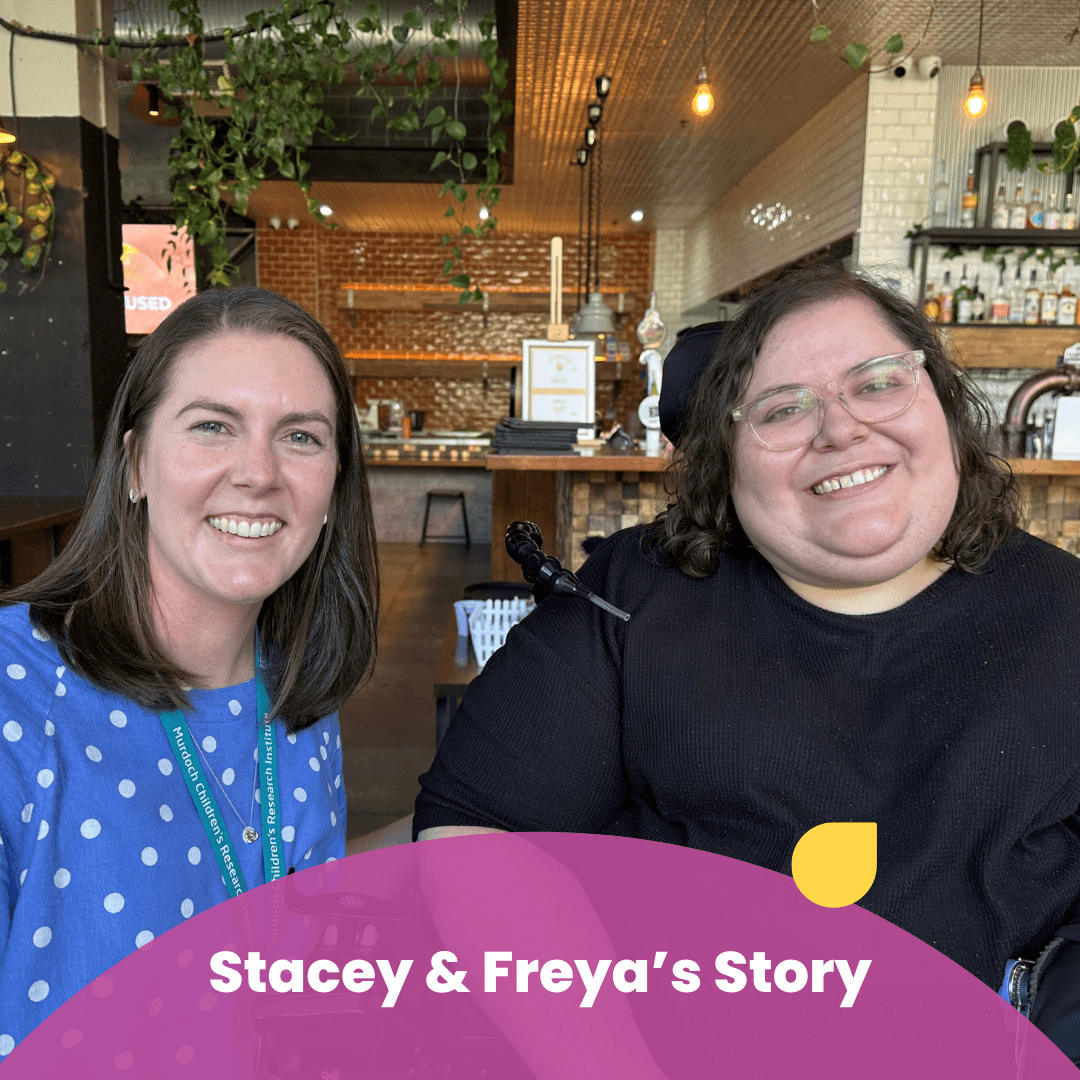
Freya, an adult with cerebral palsy, and Stacey, a postdoctoral scholar, share their story of working together on CP-Achieve's consumer research project
How do you develop relationships in a research team when you have limited experience? For Freya, a consumer research partner with cerebral palsy, and Stacey, a postdoctoral scholar, it involved learning through doing, being flexible and making some mistakes. As we can see in this story, consumer involvement can build both the confidence and skills of all the research team.
The first meeting
“I was pretty nervous when we first met”, said Freya of her first meeting with Stacey. Neither of them had any experience with consumer involvement, or scoping reviews. “I remember Stacey asking lots of questions on how she could best support me. I could tell she was nervous as well”, recalls Freya.
Working out how to work together
Both Stacey and Freya, took time to work out how to work together. At the start, Freya explains “it was difficult for us consumer research partners to understand how the research process worked”.
Importantly, Stacey was really good at accommodating the needs of consumer research partners. According to Freya, Stacey “recognises that everyone works differently” and adjusted the research process to suit the consumer research partner’s needs.
Stacey initially sent documents for review by email, but soon realised it was more effective to discuss the content during meetings. “The team preferred to review documents together rather than individually”, she explained, “so I began sending documents out ahead of a meeting time to help the team prepare”.
Freya explained how Stacey also accommodated her needs by taking notes for her, “I struggle with notetaking, and Stacey would ask, ‘Do you want me to take notes, or what points do you want me to write down?’”.
After consumer research partners shared that they needed more time to consider things, Stacey adapted the research approach, saying “We ended up extending meeting times as we realised we just needed more time to talk!”. This change really benefited the research team, as Freya explained “now there is less time pressure, and we have a more meaningful say”.
External Content
What does this mean?
We've sourced this content from a third party. At the time we published this, we decided it was useful and valuable information.
Because we aren't in control of the original file, we aren't able to guarantee the quality of the content will always be up to our standards.
Communication
Initially there were gaps in the research process, due to the research stage, Stacey’s part-time working status, and her other responsibilities (such as grant writing). Recognising that the gaps, although at times unavoidable, were unhelpful for maintaining momentum, Stacey started an instant messaging group to stay in touch. She explains “Using the messaging platform, I could keep the consumer research partners abreast of my activities and timelines and build and maintain our relationships. The team preferred the instant messaging group over email for smaller tasks or quick questions”. According to Stacey “This really improved our relationships”.
Stacey’s responsiveness to the situation was really appreciated by Freya, who stated, “The communication side of things has improved drastically with a greater understanding of our needs”. She added, “Having multiple ways to receive notifications has been really helpful”.
Influencing the project
According to Freya, consumer research partners working with Stacey have “had a lot of say on different things and really influenced this project”.
Stacey typically shared all the research data with the consumer research partners, but she would also ask them to comment on specific aspects, recognising that their lived experience would give them specific insights. According to Freya, Stacey would say, ‘You’re better placed to comment on this than I am’.
Freya drew from her lived experience to shape the recommendations from the scoping review, which were included in a journal article. She was also pivotal in responding to the comments made by the reviewers as part of having the journal article accepted for publication.
She explained “The suggestion from the peer reviewer was to reduce the impact of negative social attitudes on people with cerebral palsy by providing them with coaching on how to manage these. Our perspective was that while it might be useful in the short term, it doesn’t solve the issue in the long term of society having bad attitudes towards disabled people”. She explained “we shouldn’t be focusing on trying to build people with cerebral palsy’s resilience and ability to deal with ableism, instead we are trying to change the system itself”.
Developing research skills
According to Freya, time and practice has made her more comfortable as a consumer research partner; “It has become easier as we have all developed skills in working together as well as just getting used to how the research process works”.
Building confidence in her own capacity to work and in the value of my work was a key benefit of Freya’s involvement in this project. She stated, “I have learnt what accommodations I need to work most effectively, and this has made it easier for me when I am working with a new researcher” She explained how her newfound confidence has led to new work as a Lived Experience Tutor teaching a subject on disability to medical students, alongside a medical tutor. She explained “a lot of the skills I learnt and developed through CP-Achieve empowered me to be able to get the job and do the work”.
For Stacey, having consumer research partners involved in the project also improved her confidence in producing a scoping review, as she explains, “I feel much more confident in the research outcomes and my role in producing this work because I wasn’t trying to interpret data without lived experience. They [the consumers] were there to help with that and that’s their expertise”.
The relationship over time
How about the research relationship? How has it evolved? Freya shared “I’ve discovered that Stacey is a lovely person. We have a lot of fun working together”. Stacey agreed, stating “I really like Freya and the other consumer research partners. It is fun to meet with them, and I enjoy working with them”. According to Stacey, the research partnerships between consumers and researchers has “been a really beautiful collaboration.”

This story appears in Chapter 8 of Navigating consumer involvement in health and disability research, a resource designed to strengthen consumer involvement practice in health and disability research.
Read the full resource: Navigating consumer involvement in health and disability research