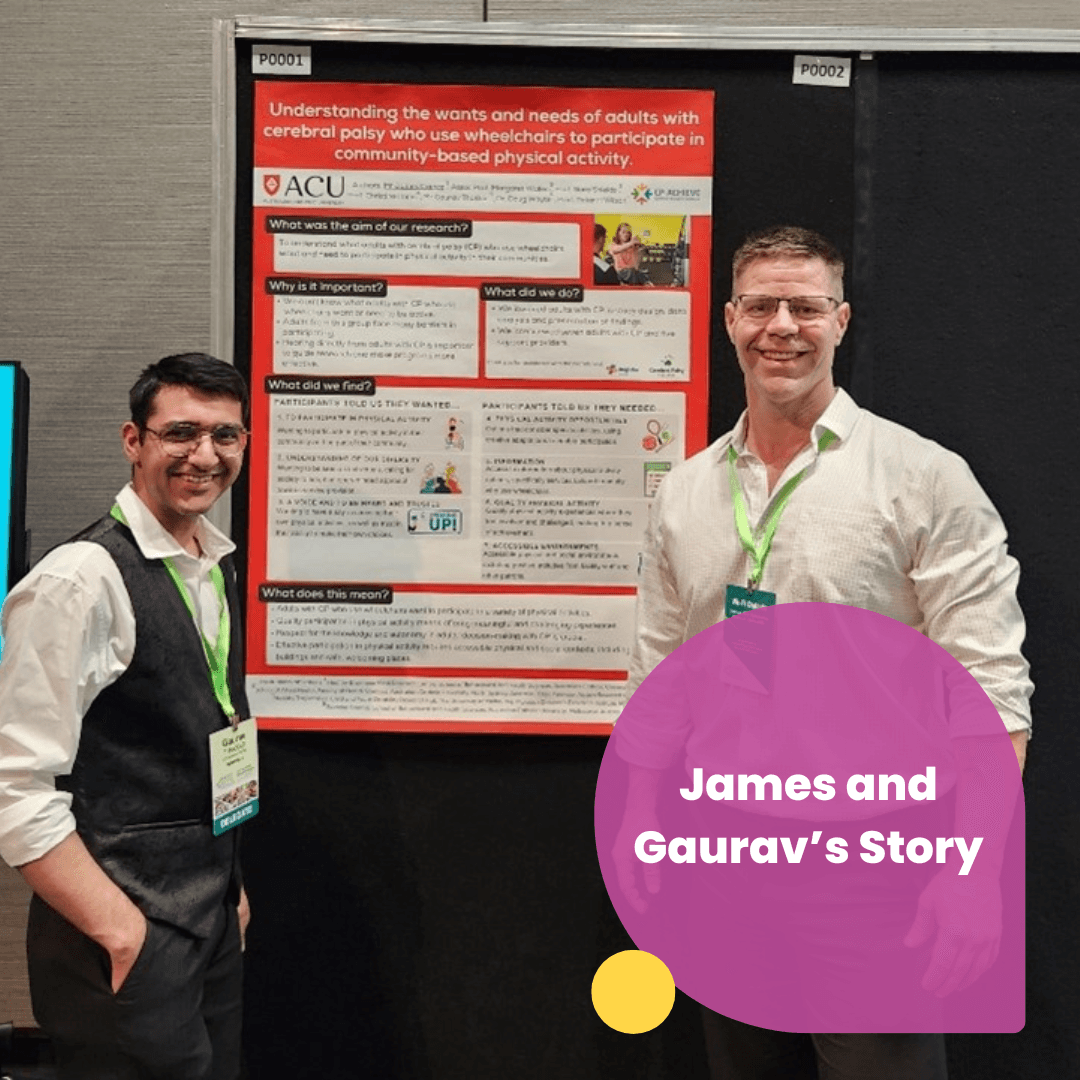
Gaurav, a young adult with cerebral palsy, and James, a PhD candidate and physiotherapist, share their story of collaboration through research with CP-Achieve
What does consumer involvement in research really look like? For Gaurav, a young adult with cerebral palsy, and James, a PhD candidate and physiotherapist, it meant stepping into new territory, both personally and professionally—and discovering the value of working together.
“When I joined CP-Achieve, I wasn’t sure how I could contribute or what my role would be,” Gaurav recalls. After finishing Year 12 and transitioning from the Royal Children’s Hospital to the adult health system, he was introduced to the program’s advisory group, CP-Unite.
Initially, I hesitated, unsure of how much I could help. But I decided to give it a try and embrace the opportunity to try something new.
Gaurav expressed interest in becoming more involved in individual projects. He was soon partnered with James, whose research focuses on improving participation outcomes for people with cerebral palsy. “As a consumer research partner, I provided feedback on the study’s processes to ensure they aligned with the needs of adults with cerebral palsy,” Gaurav says. “My involvement helped refine the research methodologies, including testing quality-of-life measurement tools.”
James found this partnership both grounding and energising. “Involving consumers in my PhD research motivated and assured me that I was on the right track and could make a difference,” he explains. “As physiotherapists, or parents working with people with cerebral palsy, we’ve got to stop being the ‘no’; we’ve got to start being the ‘yes—how can we make it happen?’”
External Content
What does this mean?
We've sourced this content from a third party. At the time we published this, we decided it was useful and valuable information.
Because we aren't in control of the original file, we aren't able to guarantee the quality of the content will always be up to our standards.
The pair’s work extended beyond planning meetings and data collection. Together, they travelled to Port Campbell to trial an accessible beach intervention, and later, to Cairns to co-present their research at a national conference. These trips were more than academic exercises.
“Warrnambool was the first time I’d been away from home,” Gaurav says. “It was my first road trip, my first sleepover, and the first time I went swimming and surfing. It allowed me to grow as a person and experience many personal firsts.”
For James, the experience highlighted the need to think more holistically. “I’m always thinking about physical and cardiovascular function, but there were all these other things I needed to consider—our travel schedule, making sure Gaurav had the right food, and felt comfortable and supported.”
Their final day in Cairns saw Gaurav snorkelling the Great Barrier Reef for the first time—despite not being a strong swimmer. “We had a wetsuit, a pool noodle, a rescue ring, and a life vest,” James recalls. “Gaurav went out twice and snorkelled on the reef. It was just brilliant.”
Beyond the adventures, their relationship evolved. “Initially, it was a working relationship,” says Gaurav.
Over time we have become good friends. If I have anything I need to share with James—about the research or my disability—I can, and he can share with me too.
Now that the research project is wrapping up, both reflect on what they’ve gained. “The quality of Gaurav’s work is above and beyond,” James says. “We’ve developed a strong friendship that will last beyond this project.” And for Gaurav, the growth is clear. “I developed independence, self-confidence, and social connections. I learnt how to advocate for myself, and what’s involved in research. It’s something I never expected I would be learning.”

This story appears in Chapter 10 of "Navigating consumer involvement in health and disability research", a resource designed to strengthen consumer involvement practice in health and disability research. Read the full resource: Navigating consumer involvement in health and disability research