

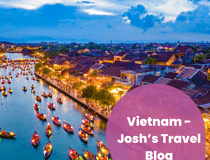
Josh, a young adult with cerebral palsy, reflects on his recent trip to Vietnam from an accessibility perspective
In January 2023 I departed Australia for a five-week holiday exploring Vietnam, Cambodia and South Korea. Vietnam and Cambodia have come a long way in recent decades of growth and development, but they still differ in providing some of the comforts and conveniences we are used to in Australia, especially when it comes to accessibility for people with disability. Part one of this three-part series will evaluate my experience of Vietnam’s accessibility in four key areas: Airport, Hotels, Transport, and Tourist Attractions. Parts two and three in separate blog posts will look at Cambodia and South Korea.
Airport Rating: 3.5/5
When I first exited the airport, past all the security and custom checks where surprisingly my ankle-foot orthoses (AFOs) did not phase them, I was greeted by just a chorus of people trying to sell their wares. From sim cards to taxi transport, everyone was selling something different, and much of it did not seem legitimate. This could have been quite daunting and overwhelming as everyone is trying to get your attention, but thankfully we had pre-booked a taxi before we departed Australia, so that alleviated all the fuss of arriving in a foreign country.
Another aspect to think of when booking flights is layover or transfer time. On our flight from Melbourne to Hanoi, we had a stopover for less than an hour. Little did we know that it was a self-transfer, so we had to find our bags and then transfer them to be loaded onto the new plane. We also had to go through security again. As part of going through security you must take your shoes off.
Hotels Rating 3.5/5
We got to our hotel for the first few nights before our tour began and checked into our room. Our room was on the 9th floor but when we get into the elevator, we discover that it only goes up to the 8th floor, so we must take our bags the rest of the way up the stairs. Most of the other hotels on this trip were budget hotels but were accessible and had the same kinds of comforts we are used to in Australia, with the exception that some hotels did not have running water and some rooms didn’t have any windows which took a bit of getting used to. Some rooms even had fake windows; they had glass looking onto a wall with a light on it!
Travel Rating: 2.5/5
The moped is the predominant mode of transportation in Vietnam, and they are everywhere. Going down the street you must be alert of moving traffic, and you also have to dodge all of the parked mopeds that are taking up the footpath, leaving you to juggle walking on the side of the footpath and step onto the road at points. I was walking down a footpath dodging parked mopeds when I accidentally knocked one on my way past and set off a loud alarm.
Once you have mastered getting around on the footpaths, you then have the task of crossing the road. In main cities like Hanoi or Ho Chi Min, there are some pedestrian traffic lights, but those are few and far between. Instead, you must walk at a steady, consistent pace for the traffic to go around you. If that's too daunting to start with, you can always wait for a local and just follow them when crossing. Remember that the traffic, while hectic, does drive a lot slower than in Australia.
Another way to travel is via tuk-tuk or rickshaw. These can be signalled from the side of the road or booked on the Grab app (like uber). These are often pulled by pushbike, and you sit in the back in a seated area.
As part of my trip, some travel was by overnight train. In these trains you have a room with two bunkbeds sleeping four people. I chose the bottom bed as it is easier to get into but when sleeping you can feel every movement of the train, and on an 18hr journey that really impacts your sleep. Drinks and food can be ordered on the overnight trains via a QR code or at the cafeteria carriage (if it's staffed when you get there). Toilets on this train are basic and like most Southeast Asian destinations, you must place toilet paper in a provided bin to not clog and overflow the toilets.
Tourist Attractions: Rating: 3.5/5
As this section of the adventure was a part of a tour with a travel company, some activities were included and others were optional. Most of the activities included were walking tours around the city with a tour guide and were accessible to me. One of the optional activities I didn't do was riding on the back of a motorbike. On a short hike to Marble Mountain, there was a lift at the base of the mountain to the top but there were still quite steep stairs to access the rest of the caves.
Final thoughts: While Vietnam is amazing and some highlights of my time there were kayaking in Hạ Long Bay and experiencing the culture, there is still a way to go to make the country accessible to tourists with a disability. I did also get some stares and looks due to my AFOs, but that is not too unexpected as this type of mobility aid would not be seen there much. Overall, my trip to Vietnam was very enjoyable and I would definitely recommend it to those who are able to.

This blog post has been provided by Cerebral Palsy Support Network in collaboration with My CP Guide. For more information about travel and holidaying as a person with cerebral palsy, My CP Guide hosts a variety of information resources. Browse the Leisure & Recreation category on My CP Guide to find other relevant resources.