Amy's story
Communicating with others is an important part of our lives. In the lead-up to World CP Day on October 6th, we are highlighting the #MillionDifferentVoices that people with CP use to communicate. Sometimes, people with CP may use Augmentative and Alternative Communication (AAC) methods rather than spoken language.
Amy, an adult with cerebral palsy and disability advocate, recently opened up about the challenges she faces communicating, and how she navigates them.
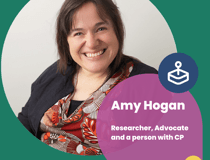
My name is Amy Hogan, and I live with cerebral palsy and am a wheelchair user. I also have what could be termed as a “mild” speech impairment. As part of my role as an advocate, it is important for me to highlight the aspects of living with CP that people may not think about, such as communication difficulties
Technology has become an important aspect of how I navigate both my speech impairments and any psychological aspects that come from it.
While I primarily communicate using speech and my voice, there are times when I find that challenging. While most people can understand my speech in general circumstances, it took many years for me to become confident to talk in situations where I don’t know many people. When I am excited or nervous, my vocal cords tighten as part of the spasticity. My breathing pattern becomes different and many of the words lose their clarity. Individuals with English as their second language, crowds, and people in social settings can find listening to me a challenge. There is also a marked difference between my speech quality in the morning and in the afternoon after work or studying for my thesis.
One aspect of my daily life that my speech impacts is the ability to use the phone, particularly when it comes to “cold calling”. Until I was around 13 or 14, I often had my parents make such phone calls for me because I was too self-conscious about making a mistake or having to repeat myself. Often, I find the more somebody asks to repeat myself, the worse it gets because I’m feeling apprehensive. However, I have gradually developed skills to deal with both my perception and other people’s challenges. It’s an achievement in the office when I can take and manage phone calls from our general membership.
An example that is meaningful to me is the negotiation with the taxi dispatch service who I use regularly. The primary dispatcher is a lovely man, but he struggles to understand how I say street names and numbers, particularly if they are in Te Reo or sounds similar to other places. Part of my speech is the ability to clearly articulate consonants, vowels, and points of emphasis. We have designed a system where I text him if I’m going somewhere new with the Google address and key demographic information. Technology has become an important aspect of how I navigate both my speech impairments and any psychological aspects that come from it.
I wanted to do this blog because raising awareness about speech and asking for compassion and understanding from the wider public is a part of advocacy. Society expects communication to be rapid with the onset of technology. However, sometimes it is equally vital to slow down and give people the opportunity to articulate what they are trying to say whatever medium they use.
Until I was around 13 or 14, I often had my parents make such phone calls for me because I was too self-conscious about making a mistake or having to repeat myself.

If you are looking for resources when it comes to communication, we have a number of information resources available on our site. Visit the Communication section for more information on the tools and resources available to support you. You can also search “AAC” on our site to find resources about Augmentative and Alternative Communication.